Local Space: What Hundreds of Unity Projects Taught Me About Drift
Oct 12, 2026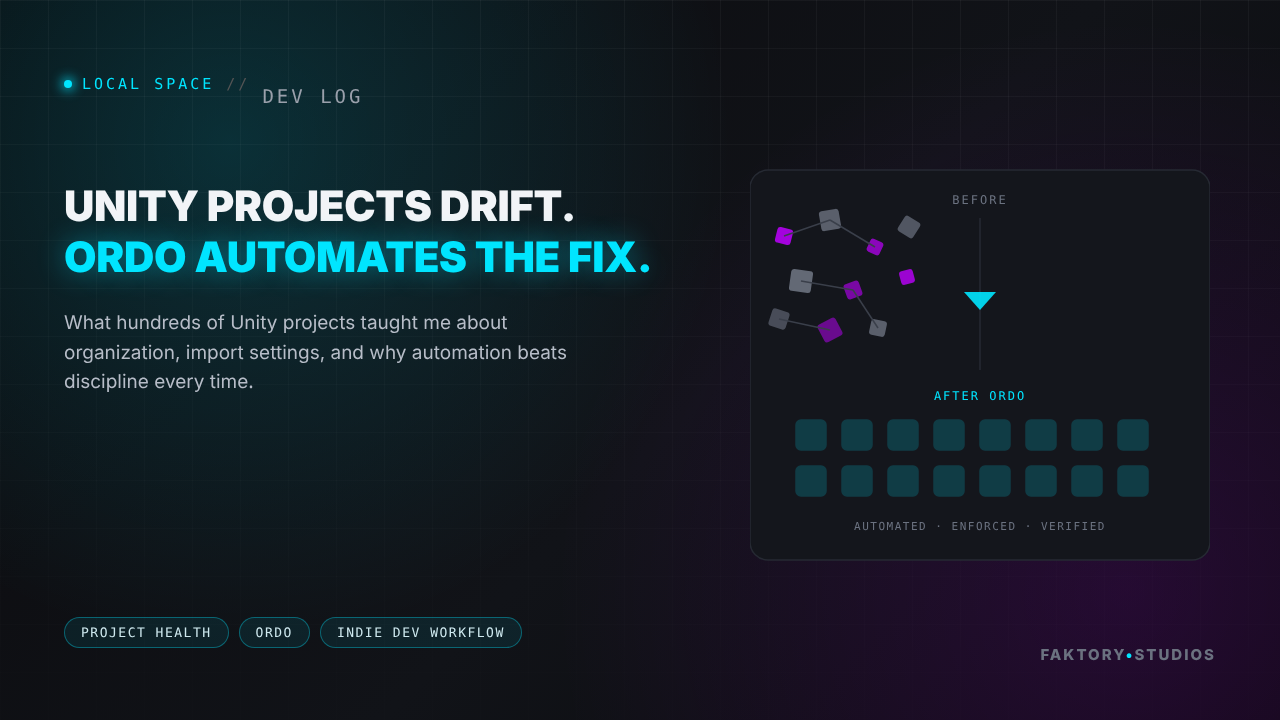
Welcome to Local Space.
If you are new here, this is my recurring dev log. I spend my week building in Unity, figuring out how to make things work, and inevitably breaking them. Then, I share the notes, tools, and code snippets that actually survived the process.
This week's log isn't about a new Unity feature. It's about a pattern I've now seen enough times to stop calling it bad luck: the scenarios that make a Unity project drift, why discipline alone never fixes it, and the tool I automated the fix into, ORDO, plus where I'm taking it next.
If any of the scenarios below sound uncomfortably familiar, jump on the Discord and tell me your version. I collect these.
1. The Scenarios You Already Know (Problem Deep Dive)
If you've shipped more than one Unity project, at least one of these has happened to you:
- The missing script, found at the worst time. A prefab that worked last week throws a "referenced script is missing" warning the day before a build, because something got renamed three sprints ago and nobody checked the references.
- The import setting that reverted itself. A texture comes in at 4K with mipmaps on because the folder it landed in has no enforced policy, and now your mobile build is twice the size it should be.
- The onboarding tax. A new teammate, jam partner, or student joins the project, and "here's how we organize things" turns into a wiki page they read once and never again.
- The pre-release scramble. Everything was fine for months, until a release candidate build turns up a scene that errors on one machine and not another, because local settings quietly drifted apart.
💡 None of these are dramatic on their own
That's exactly the problem. Each one is small enough to ignore in the moment, which is how they all show up together, right when you can least afford it.
2. What Hundreds of Projects Taught Me (Solo Dev Spotlight)
I'm a solo developer. Between my own games, client work, and the templates, shader packs, and courses I ship through Faktory Studios, I've been inside hundreds of Unity projects at this point. Different genres, different team sizes, different skill levels. And the organization and import-setting drift above shows up basically every time, regardless of how careful the person running the project was on day one.
It doesn't matter if it's one person or a team of ten. Organization is clean for the first month or two. Import settings are fine until someone drops in an asset pack with its own ideas about compression. The usual fix, a style guide, a pinned Discord message, a Friday cleanup pass, survives right up until the first real deadline, and then nobody has time for it anymore. I tried all of those fixes myself, on my own projects, before I ever thought about building a tool.
🎮 The real lesson
Organization isn't a discipline problem. It's a tooling gap. You don't fix it by trying harder or writing a better doc, you fix it with something that enforces the rules whether or not anyone's paying attention that day. That's the entire premise ORDO is built on.
3. What ORDO Automates (Feature Deep Dive)
Everything below used to be a manual habit I was relying on myself (or a teammate) to remember. ORDO does it automatically instead:
- Self-enforcing organization. Pick a starter template or build your own, and new assets land where they belong, with approval gates wherever you want a say, especially for scripts.
- Correct import settings on arrival. Textures, models, and audio get the right policy the moment they land, not whenever someone remembers to check the inspector.
- Real findings, not noise. A scan surfaces missing scripts, broken references, and import drift, each with severity, evidence, and a concrete way to verify the fix.
- One policy, every machine. Export a policy file, commit it like any other project setting, and ORDO flags drift automatically the moment a local setup stops matching it.
- CI-ready. The same readiness scan runs headless from the command line, so a broken prefab fails the pull request instead of the release.
It's Editor-only, so none of it ships in your game, and it never deletes a file. Worst case, it tells you something's wrong. It never makes things worse.
4. Try It This Week (Hidden Gem)
You don't need a messy project to get value out of this, just one that's going to keep growing. Setup is genuinely about five minutes:
- Back up or commit your project, then import ORDO.
- Open Tools > ORDO > Open ORDO and install a starter template, or build your own.
- Click Create Project Folders, choose your automation settings, and run your first Scan Project.
- Work through what it finds. The Overview tab always tells you the next step.
Get ORDO on the Unity Asset Store and see what it turns up in your own project.
5. Where ORDO Is Headed (Business of Indie Dev)
ORDO isn't an asset I shipped once and walked away from. I use it on every project I touch through Faktory Studios, which means every edge case I run into becomes the next thing I fix or add. It's actively evolving, and it gets more effective with every release, not just more features. Here's the direction I'm taking it:
- Deeper finding coverage. More issue types caught per scan, as real projects surface new ways things can drift.
- More starter templates, and better custom ones. Covering more project shapes out of the box, with easier tools for building your own.
- Richer CI reporting. More detail in the headless JSON report, so a build server can act on more than a simple pass or fail.
- Clearer policy diffs. Better visibility into exactly what a shared policy change affects before a team applies it.
💡 The roadmap isn't fixed in stone
It moves based on what real projects throw at it, which is how ORDO got built in the first place. If you hit a drift problem it doesn't catch yet, tell me on the Discord. That feedback is the actual roadmap.
// When you are ready
Here are 3 ways I can help you level up your game dev journey:
Local Space is a production of Faktory Studios.
© 2026 All rights reserved.
Join the Local Space Newsletter
Weekly Unity dev tips, tools, and short lessons to help you build faster and ship real projects.
We hate SPAM. We will never sell your information, for any reason.