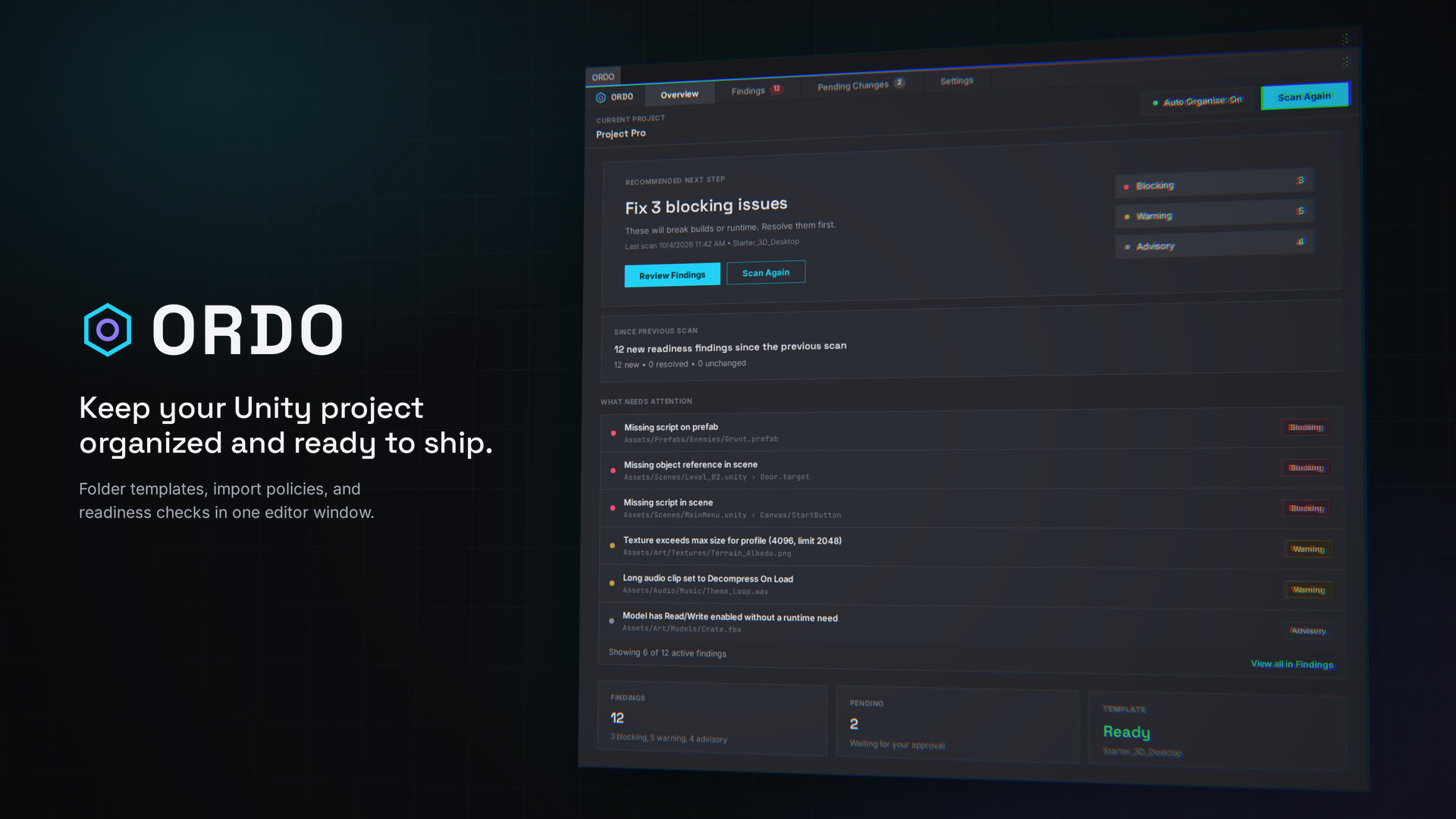
Find Unity project risks before release.
ORDO checks texture, model, and audio import settings, plus missing scripts and broken references in prefabs and scenes.
For Unity 2022.3 LTS and newer. Editor-only, with zero footprint in game builds.
33
built-in import policies
0
footprint in game builds
2022.3+
Unity LTS and newer
The problems you find at the worst possible time
Read/Write left on
A model ships with Read/Write left on.
Audio that doubled the bank
Audio that should have been mono doubled your bank size.
A script lost three merges ago
A prefab lost a script three merges ago and nobody noticed.
Settings that drifted
Textures drifted off the filter and compression settings the project agreed on.
None of it breaks the Editor. It just quietly costs you build size, memory, and time, and you find it the week you are trying to ship.
ORDO is an Editor tool that checks for these conditions on demand, tells you exactly what and where, and verifies the fix.
How it works
1. Scan
ORDO evaluates a defined set of readiness conditions across your project: textures, models, audio, prefabs, and scenes.
2. Understand
Each finding has a severity (Blocking, Warning, or Advisory), the rule it violates, and the expected-versus-actual evidence behind it. Evaluation errors are shown separately, so a scan that could not check something never looks like a clean result.
3. Fix, with your confirmation
Import-policy findings have a one-click fix that shows you what it will change, changes only that field, and reimports. Missing scripts and broken references are guided, not auto-removed. ORDO never deletes a component or clears a reference for you.
4. Verify
Nothing is marked resolved until a rescan confirms it. A clean scan means the checks ORDO runs passed. It is not a claim about the whole project.
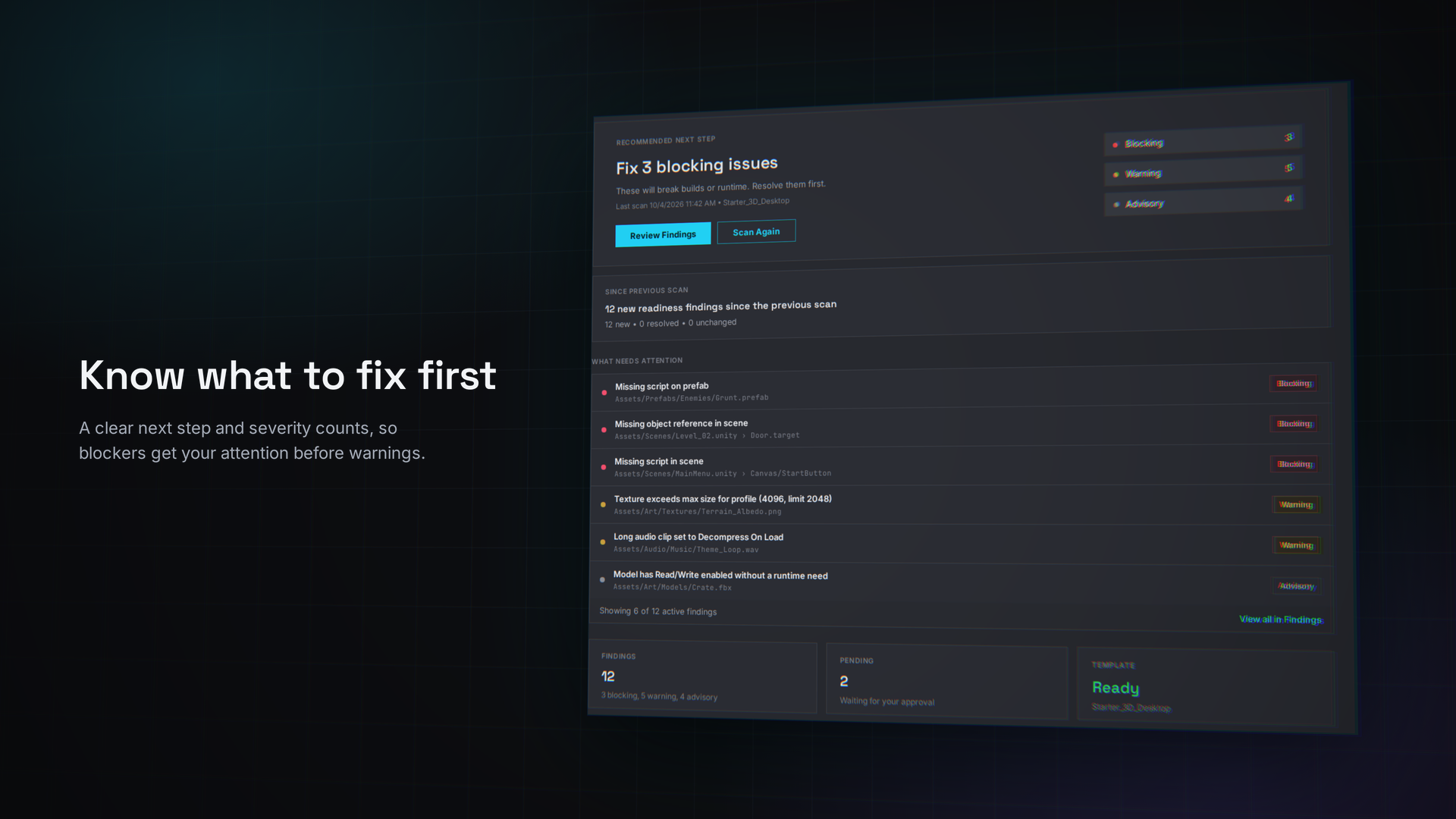
What a scan checks
- Textures: mipmaps, filter mode, anisotropy
- Models: Read/Write, global scale, mesh compression, rig type
- Audio: load type, compression format, force-to-mono, ambisonic, import quality
- Prefabs: missing MonoBehaviour scripts, and serialized references whose target is gone
- Scenes: missing scripts on scene objects and broken serialized references, grouped as Scene Integrity
ORDO opens each scene safely, restores your exact scene setup afterward, and reports partial coverage (Play mode, unsaved changes) instead of skipping silently.
Evidence, not guesses
- Every finding shows its severity, the rule it violates, and the expected-versus-actual evidence behind it.
- Project Health history keeps a local snapshot of each completed scan and reports what is new, resolved, or unchanged since the last one. Snapshots stay in Library/ORDO and are never committed.
- Overview leads with the recommended next step and the most important findings.
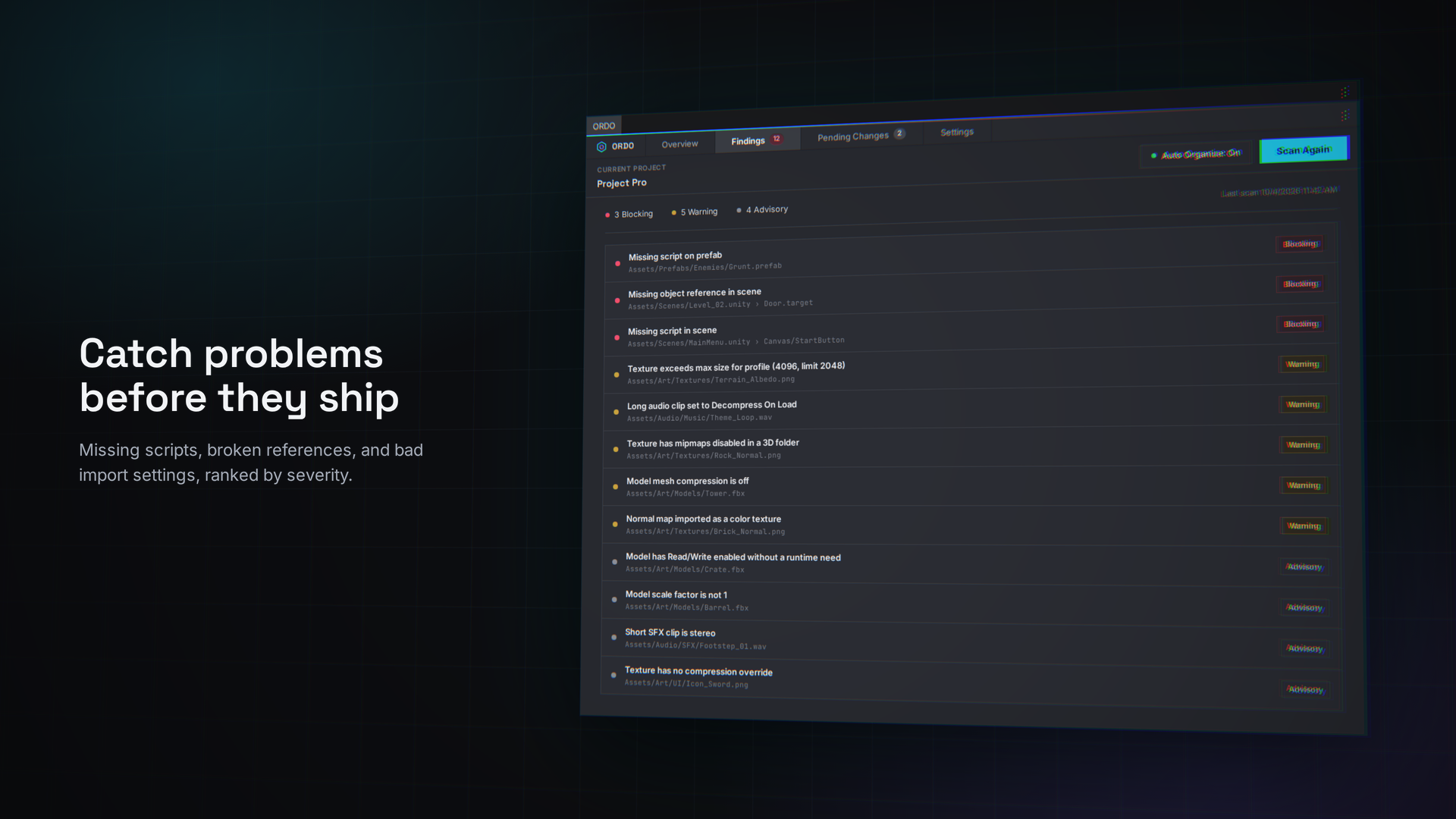
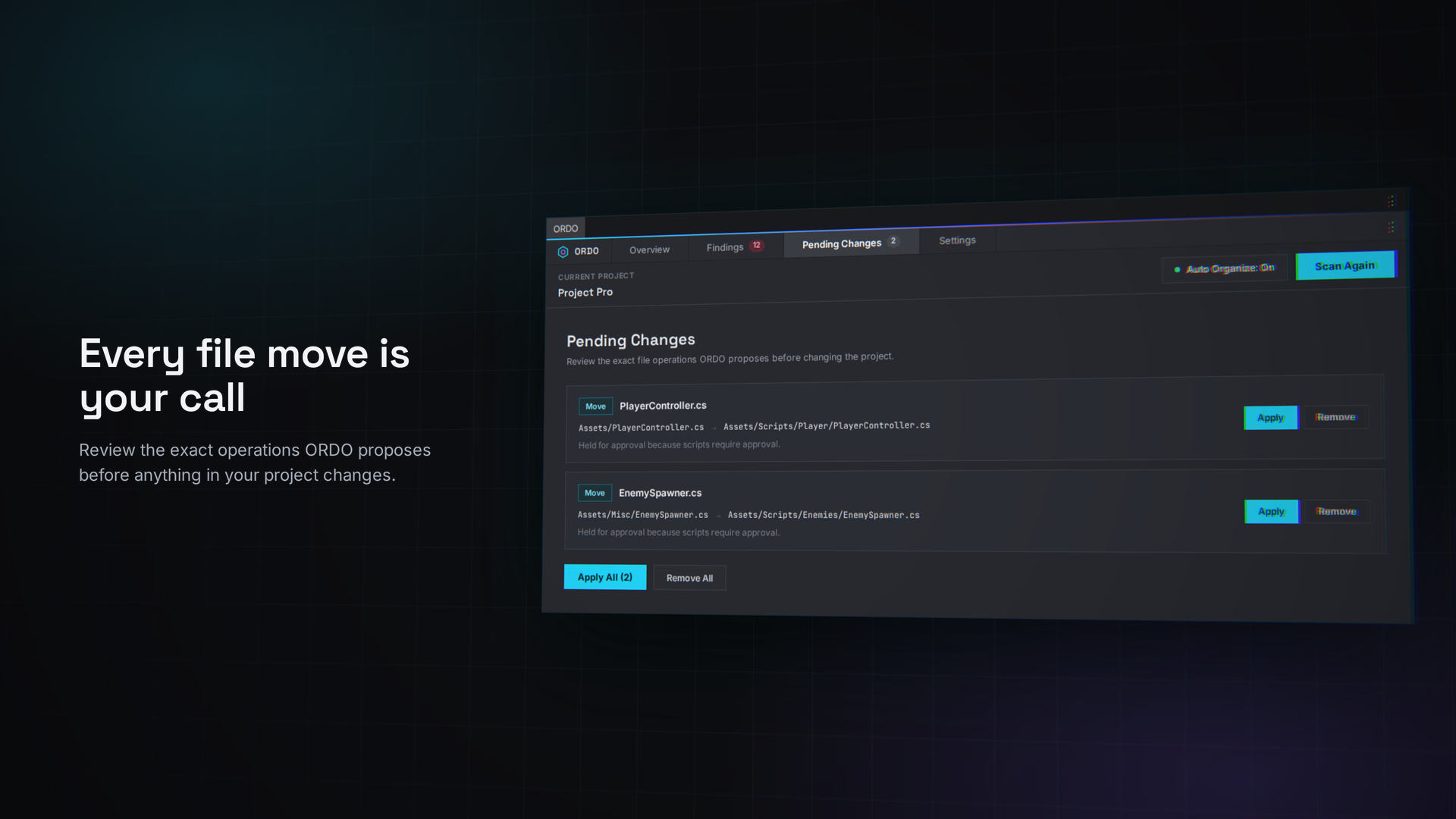
Fixes that ask first
- One-click fixes preview the change, touch only the governed importer field, reimport, and require a rescan to verify.
- Stale fixes are refused if the project or your policy changed since the finding was raised.
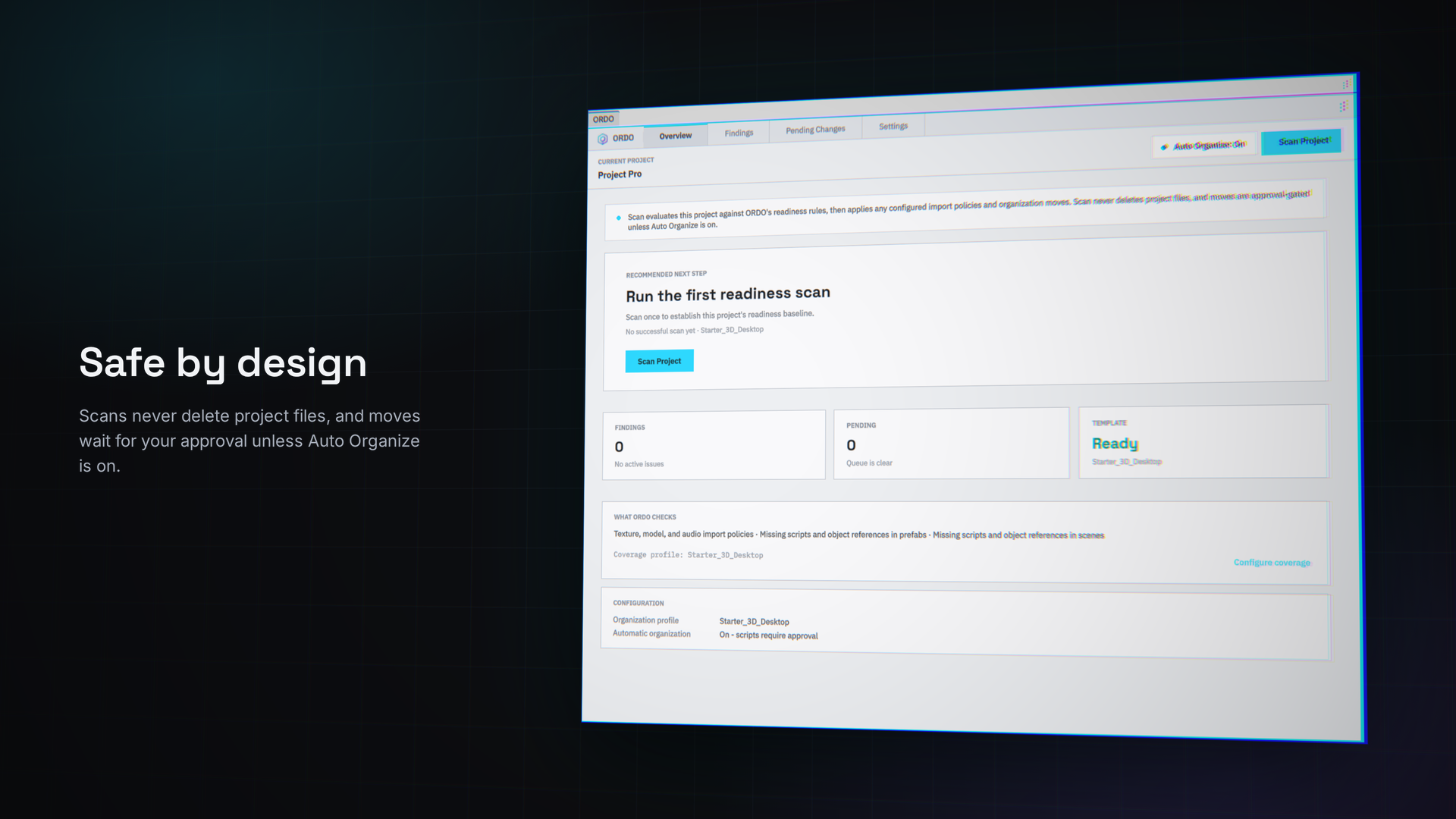
- Turn off automatic organization to review each move in Pending Changes first: exact source and destination, pre-flight checks, and verification reported separately from the move.
Set the rules once
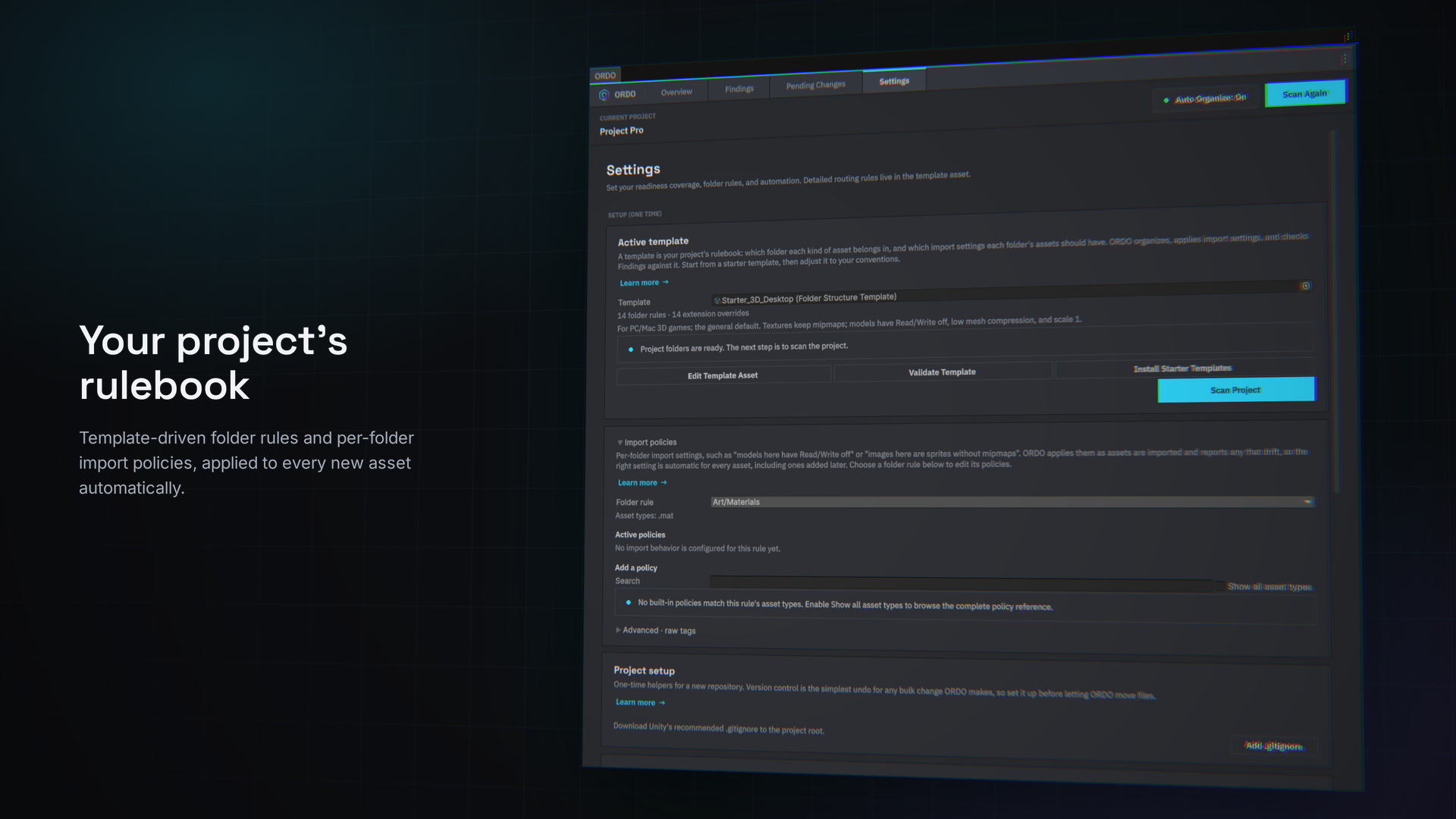
- 33 built-in import policies for textures, models, and audio, attached per folder rule and applied automatically as assets are imported. One command brings an existing project into line.
- Folder templates define where every asset type belongs, by extension, filename pattern, or priority. They ship for 2D, 3D, mobile, VR, AR, console, and WebGL, and you can edit them or build your own.
- Automatic organization files new and moved assets into their template folder through Unity's asset database, so references, prefab links, and scene assignments stay intact.
- Keep Here exceptions exempt a single asset, a file type, or a whole folder from reorganization without turning off the readiness checks.
Built for teams, careful with your files
- One policy for the team. Export your folder rules and import policies to a single ProjectSettings/ORDO.policy.json and commit it, so every developer scans the same way. ORDO tells you when your local setup has drifted from the committed file. Fully offline, no account.
- Version-control aware. Overview warns when it cannot detect version control, before ORDO moves or rewrites anything. One click adds Unity's recommended .gitignore to the project root.
- Careful with your project. Scans never delete project files, and ORDO never removes a component or clears a reference.
Runs in CI
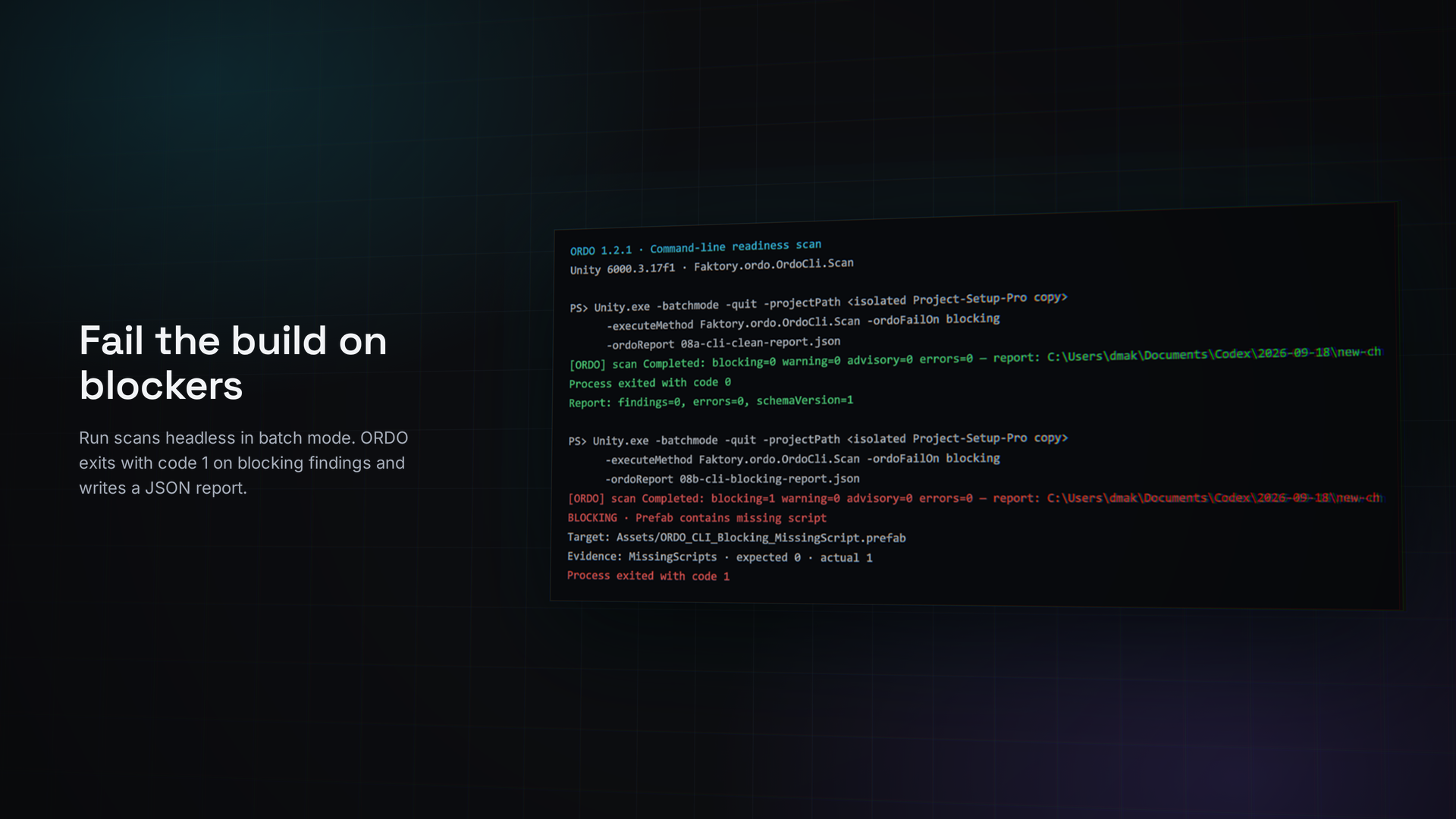
Run a read-only readiness scan in batch mode with no Editor window. ORDO writes a structured JSON report and exits non-zero when there is a Blocking finding, which is enough to fail a build. It never moves assets or changes importers.
Unity.exe -batchmode -quit -projectPath <project> -executeMethod Faktory.ordo.OrdoCli.Scan -ordoFailOn blocking -ordoReport ordo-report.json-ordoFailOn accepts blocking, warning, or none.
Scope, stated plainly
ORDO checks the coverage it shows you: texture, model, and audio import policy, plus missing scripts and broken serialized references in prefabs and scenes. A clean scan means those checks passed. It does not certify whole-project readiness: no build-settings or Addressables validation, no required-field or required-component checks, and no general scene validation beyond the integrity checks above.
Details
- Compatibility: Unity 2022.3 LTS and newer.
- Editor-only: runs entirely in the Unity Editor, with zero footprint in game builds.
- One window: Tools > ORDO > Open ORDO gives you Overview, Findings, Pending Changes, and Settings as tabs in a single workspace. Light and dark theme-aware.
- Documentation: a full manual (HTML and PDF) is included in the package, and the online documentation is always available.
Questions
Will ORDO delete or change my files without asking?
ORDO never removes a component or clears a reference, and scans never delete project files. Import-policy fixes preview the change and need your confirmation. Automatic organization files new imports into their template folder through Unity's asset database so references stay intact, and you can turn it off to approve each move in Pending Changes.
Does a clean scan mean my project is ready to ship?
No. A clean scan means the checks ORDO runs passed: texture, model, and audio import policy, and missing scripts and broken references in prefabs and scenes. It does not certify whole-project readiness.
Can I run ORDO in CI?
Yes. Run -executeMethod Faktory.ordo.OrdoCli.Scan in batch mode. It is read-only, writes a JSON report, and exits non-zero when there is a Blocking finding.
Does ORDO add anything to my game build?
No. ORDO runs entirely in the Unity Editor, with zero footprint in game builds.
Which Unity versions does it support?
Unity 2022.3 LTS and newer.
Find the risks before release.
Catch the import-setting and integrity problems that cost build size, memory, and debugging time while they are cheap to fix, not during release crunch.